
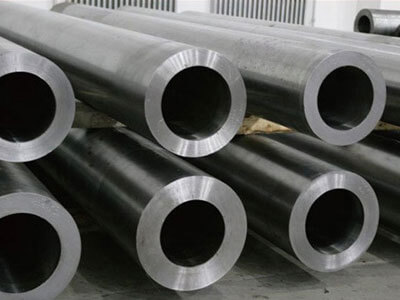
General characteristics
Low-alloyed ferritic heat resisting grade with improved scaling resistance. Uncritical regarding embrittlement at service temperatures. Applied for e.g. furnace equipment, thermal boiler components, grids, burner nozzles, conveying parts, thermowells. The high temperature (HT) ferritic stainless steels complement Dinesh Tube India's austenitic heat and creep portfolio. The main alloying element in the ferritic grades is chromium. Its positive effect on the scaling resistance is enhanced by silicon and aluminium. The characteristic properties are excellent resistance to oxidising and reducing sulphur containing atmospheres, good resistance to oxidation and high thermal conductivity with low thermal expansion. 4713 does not form brittle phases but should only be exposed to moderately corrosive atmospheres owing to its low chromium content. 4724 is a truly stainless high temperature grade with 13% chromium. It is not critical in terms of embrittlement. 4742 shows better scaling resistance than 4724 and can be subjected to reducing sulphur environments without risk. It is subject to 475°C embrittlement and grain coarsening at temperatures above 950°C. σ-phase may form after long time exposures to temperatures around 650°C. 4762 - with the highest chromium content- is the most resistant to reducing sulphurous gases. It is susceptible to the same embrittlement phenomena as 4742 whilst σ-phase forms during long exposures in the range 600°C to 800°C.
Characteristic temperatures
The characteristic temperatures for the different grades are shown in the table below.
| Steel grade | Maximum service temperature in dry air,ºC | Hot forming1,ºC | Annealing2,ºC |
|---|---|---|---|
| 4713 | 800 | 1100-750 | 750-800 |
| 4724 | 850 | 1100-750 | 800-850 |
| 4742 | 1000 | 1100-750 | 800-850 |
| 4762 | 1150 | 1100-750 | 800-850 |
1 Cooling still air 2 Cooling forced air or water
Creep strength
Creep properties of 47XX, Rp0,1 N/mm2 (mean values) are shown in the table below.
| Time,h | Temperature | ||||
|---|---|---|---|---|---|
| 500 | 600 | 700 | 800 | 900 | |
| 1 000 | 80 | 27.5 | 8.5 | 3.7 | 1.8 |
| 10 000 | 50 | 17.5 | 4.7 | 2.1 | 1.0 |
Typical applications
Dinesh Tube India Stainless ferritic high temperature steels are mostly used in high temperature applications with sulphurous atmospheres and/or low tensile loads such as for installations within:
- Furnace equipment
- Thermal boiler components
- Grids
- Burner nozzles
- Conveying parts
- Thermowells
- Chemical industry (drums)
- Power industry (coal burners)
- Metalworking industry (heat treatment boxes)
Composition
- Al: 0,70-1,20%
- C: max. 0,12%
- Cr: 12,0-14,0%
- Mn: max. 1,00%
- P: max. 0,040%
- S: max. 0,015%
- Si: 0,70-1,40%
- Balance: max. %
Send the grade, size, schedule, length and quantity to info@dineshtubeindia.com or call +91 83559 10913.
Applications
- Plant manufacturing
- Machine engineering
- Power generation
- Powerplant
Delivery form
- Plate, cold rolled
- Plate, hot rolled
- Roundbar, rolled
- welded pipe/ welded tube
- laser cuts
- plasma cuts
- Rings
- Discs
- Tailormade drawings
Product forms & Sizes
Flat
| Product type | Finishes | Thickness | Width |
|---|---|---|---|
| Black hot band | 1U | 3,65-6,00 | 1000-1300 |
| Cold rolled coil | 2B, 2BB, 2C, 2D, 2E, 2G, 2J, 2R | 0,05-4,00 | 3-1500 |
| Cold rolled sheet | 2B, 2BB, 2C, 2D, 2E, 2G, 2J | 0,50-4,00 | 350-1500 |
| Hot rolled coil, pickled | 1C, 1D, 1U | 3,50-6,00 | 50-1530 |
| Precision strip | 2R | 0,05-1,50 | 3-649 |
Fabrication
Hot forming
Hot working should be carried out within the temperature ranges given under the headline. Characteristic temperatures earlier in this datasheet. Formability/ MachiningGenerally, ferrites are difficult to form in the cold condition. They are formable at room temperature when sheets are no thicker than 3 mm; 4713 even 6 mm. Thicker 4713 and 4724 plates must be preheated and formed within the temperature range 250 - 300°C. 4742 and 4762 should even be heated up to 800 - 900°C to avoid formation of any brittle phases. Generally, the minimum radius for bending deformation can be taken as “double thickness”. Machining is considered to be less problematic due to their low strain hardening rates. Welding : The same precautions as for carbon steels are normally required. Preheating of the joints to 200-300°C is necessary for plates thicker than 3 mm. Due to grain growth in the heat affected zone, the heat input should be minimised. Gas shielded welding methods such as GTA (TIG), plasma arc and GMA (MIG) are preferred. Pure argon should be used as the shielding gas. Matching filler material has detrimental effect on the ductility why austenitic welding consumables, e.g. 307, 309 or 310 are recommended. If the weld will be exposed to a sulphurous environment, overlay welding with the matching ferritic filler will be necessary.